

A secure cloud hosting provider is not the one with the most reassuring words on its homepage. It is the one that can name specific controls, SOC 2 audits, encryption, multi-factor authentication, tested backups, and answer for each of them plainly when you ask. “Bank-level security” and “military-grade encryption” are marketing, not evidence. If you are about to trust a host with your financial data, you need a way to separate the two. This guide explains the controls that actually matter, gives you the questions to ask, and shows the green and red flags that tell you which kind of provider you are dealing with.
The controls that actually matter
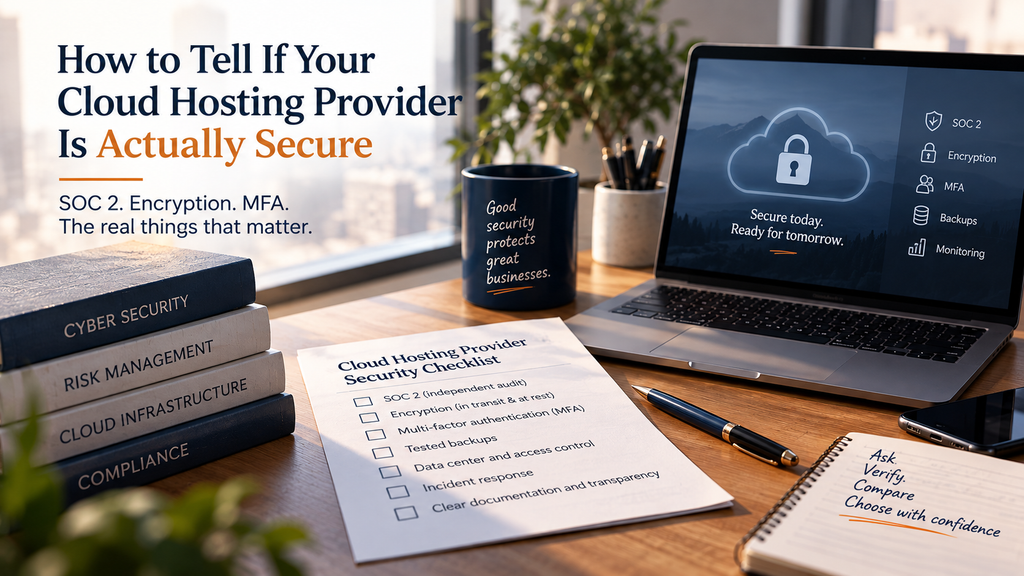
Strip away the slogans and a host’s security comes down to a handful of concrete controls. Here is what each one is and why it matters.
Notice that every one of these is checkable. A provider either has a SOC 2 report or does not. Encryption is either on for data in transit and at rest or it is not. That is the point: security you can verify beats security you are asked to take on faith.
This is also why the buzzwords fail the test. “Bank-level” describes nothing you can check, and “military-grade encryption” usually just means the same standard nearly everyone uses. Ask what standard, applied where, and whether you can see proof, and the marketing quietly falls away, leaving either real answers or an awkward pause.
How to vet a secure cloud hosting provider
Turn those controls into questions and ask them directly. A confident, secure host answers without hesitation.
- ?Do you have a SOC 2 report or an equivalent independent audit, and can I see it or a summary?
- ?Is my data encrypted both in transit and at rest?
- ?Is multi-factor authentication enforced on access to my environment?
- ?Are backups automated and tested, and how quickly can you restore?
- ?Where is my data physically stored, and who has access to it?
- ?What is your support availability, and does your team know the software or just the server?
- ?What happens to my data if I leave, and how is it returned or securely deleted?
Two habits make the answers count. Get them in writing, an email or a document rather than a reassurance on a sales call, and keep them, because those same answers are what you will need for your own records and any future audit or claim. A host that is glad to put its security in writing is telling you something reassuring in itself.
Green flags and red flags
Why this matters more for financial data
Vetting a host matters for any business, but it matters more when the data is financial. If you are an accounting or tax firm, your host is a service provider you are expected to select carefully and document under the FTC Safeguards Rule, and the controls above are exactly what that oversight looks for. In other words, the questions in this guide are not just good hygiene, they are part of your own compliance. Our pieces on the FTC Safeguards Rule and on documenting your host in your WISP pick up that thread, since a host that answers these questions cleanly is also one you can record and defend. Security is not a one-time box to tick, either. A provider’s controls should hold up year after year, which is why a repeated audit like SOC 2 matters more than a one-off claim, and why your own review of a host should recur rather than happen once at signup.
How CloudTop Office approaches security
We would rather you ask us these questions than take our word for anything. CloudTop Office runs client environments on Microsoft Azure in U.S. regions, with encryption, enforced multi-factor authentication, managed daily backups, access controls, and 24/7 U.S.-based support, and we are glad to walk through our controls and any audits as part of your due diligence. That is the whole spirit of this guide: a host worth trusting welcomes the checklist rather than dodging it. You can see how the environment is built on our QuickBooks Desktop hosting page, review common questions in our FAQ, or get a personalized quote and put our answers to the test.
Cloud hosting security questions
What makes a cloud hosting provider secure?
Specific, documented controls, SOC 2 or an equivalent audit, encryption in transit and at rest, enforced MFA, tested backups, and a known data center, plus the willingness to show evidence. Vague marketing phrases are not a substitute for any of those.
Is SOC 2 required for a hosting provider?
It is not legally required, but a SOC 2 report is strong third-party evidence of a provider’s controls. Ask any host whether they have one, or an equivalent audit, and whether they can share the report or a summary for your records.
What’s the difference between encryption in transit and at rest?
Encryption in transit protects data as it moves across the network, and encryption at rest protects it while stored on the server. A secure host uses both, so your data is unreadable whether it is being sent or sitting still.
Why does MFA matter so much?
Because a stolen or guessed password alone cannot get in when MFA is enforced. It closes the single most common path into an account, which is why insurers and auditors now treat enforced MFA as a baseline requirement rather than an upgrade.
How does vetting a host connect to my own compliance?
If you handle financial data, your host is a service provider you are expected to vet and document under rules like the FTC Safeguards Rule. A host that answers the questions above cleanly is one you can record and defend, so vetting well does double duty.
Want straight answers about a host’s security?
A 15-minute call is enough to walk through our security controls and how they would protect your financial data.
Book a 15-min consult
Leave a Reply