

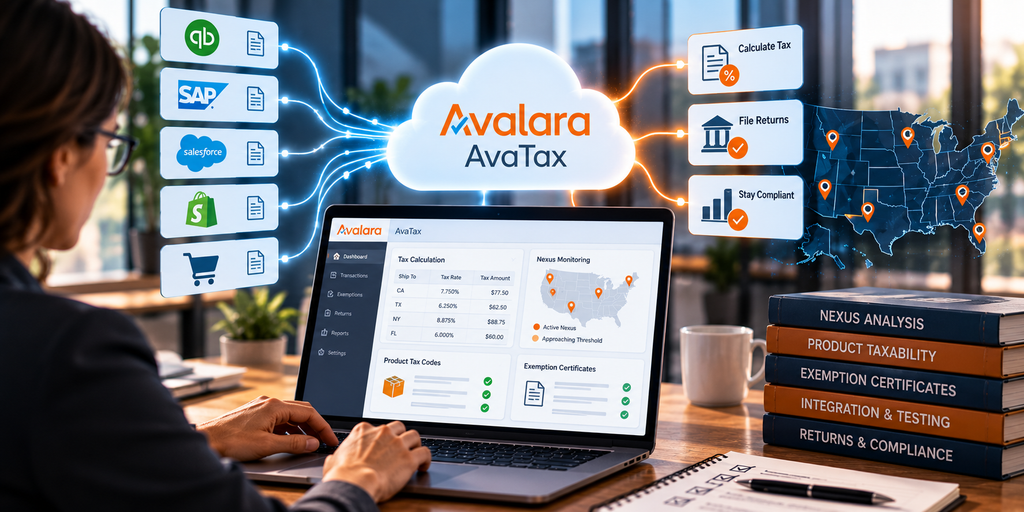
Avalara AvaTax automates sales tax, but an AvaTax implementation is only as accurate as the setup behind it. The software calculates tax in real time across thousands of jurisdictions, which sounds like it removes the hard part. It does not. AvaTax calculates tax based on decisions a person still has to make, where you have tax obligations, how each product is taxed, and which sales are exempt, and getting those decisions wrong produces tax that is confidently, consistently incorrect. This is what a proper implementation involves, where they go wrong, and why the setup matters more than the software.
What AvaTax does, and what it doesn’t
AvaTax is a cloud platform that calculates sales and use tax at the moment of a transaction, using address-level rates across more than 12,000 jurisdictions, and it monitors economic nexus so you are alerted when your sales cross a threshold in a new state. It connects to your accounting system, ERP, or e-commerce platform so the right tax appears on the invoice automatically. What it does not do is decide your obligations for you. AvaTax calculates tax based on where you have nexus, but it cannot determine that nexus itself. It does not map your specific products to the correct tax codes, clean up your exemption certificates, or validate the data flowing out of your accounting system. And AvaTax on its own calculates tax; filing the returns is a separate step handled by Avalara Returns. The software is the engine. The implementation is the steering.
What a proper implementation involves
Done properly, an AvaTax implementation is a sequence of decisions and checks, not a single install. These are the steps that make the automation trustworthy.
Where implementations go wrong
Most AvaTax problems trace back to the setup, not the software. A business skips the nexus review and ends up collecting tax in states it does not owe, or missing states it does. Products get left on a default tax code, so the calculation is wrong in a quiet, systematic way nobody notices until an audit. Exemption certificates go uncollected, which turns exempt sales into liabilities. The connector gets installed but never tested against real data, so bad addresses or item codes produce bad tax. And the most common one of all: the system is treated as set-and-forget, while nexus thresholds keep changing underneath it, as they did when seventeen states dropped their 200-transaction threshold through 2026. Automation without maintenance drifts out of compliance on its own.
Is AvaTax right for your business?
Being straight about this matters, because AvaTax is not for everyone. A single-state seller with low volume rarely needs this level of automation, and the cost and setup would outweigh the benefit. Where AvaTax earns its place is multi-state or multi-channel complexity: selling into many states, crossing economic nexus thresholds you have to monitor, running sales through more than one platform, or feeding an ERP that needs tax handled consistently across all of it. If that describes you, manual tax tables are a liability waiting to happen. If it does not, a simpler tool or approach may serve you better, and an honest assessment should be the first thing any implementation gives you.
Why a certified partner matters
Avalara’s own implementation process is structured but deliberately narrow: it installs the connector, walks you through the interface, and confirms your systems can talk to AvaTax. The decisions that actually determine whether your tax is correct, the nexus analysis, the product mapping, the exemption certificates, the data cleanup, sit outside that scope and fall to you. CloudTop Office is an Avalara Certified Implementation Partner, and that is the part we handle: the judgment and configuration that turn AvaTax from an installed tool into an accurate one. We have worked in tax and accounting systems since 2000, so we approach an implementation as an accounting problem, not just a software install. See our Avalara consulting page, or our broader consulting services, for how we work.
AvaTax implementation questions
What does an AvaTax implementation involve?
More than installing a connector. It involves a nexus review, mapping your products to the correct tax codes, handling exemption certificates, integrating with your accounting system or ERP, and testing before go-live. The software calculates the tax; the setup is what makes it accurate.
Does AvaTax figure out where I owe sales tax?
No. AvaTax calculates tax based on where you have nexus, but it cannot determine that nexus for you. Identifying every state where you have physical or economic nexus is part of the implementation, and getting it wrong means collecting in the wrong places or missing the right ones.
Does AvaTax file my sales tax returns?
AvaTax on its own calculates tax. Avalara Returns is the separate module that prepares, files, and remits the returns. Many businesses use both, and a proper implementation decides up front how your returns will be handled.
Is AvaTax worth it for a small business?
It depends on complexity. A single-state, low-volume seller rarely needs this level of automation. AvaTax earns its place once you have multi-state or multi-channel sales and real nexus in several jurisdictions. An honest assessment of whether it fits should be part of any good implementation.
Want AvaTax set up the right way?
CloudTop Office is an Avalara Certified Implementation Partner. A 15-minute call is enough to scope what a proper implementation looks like for your business.
Book a 15-min consult
Leave a Reply