

Ninety-eight percent of accounting professionals say they now use AI. That figure, from Karbon’s 2026 survey, is up about fifteen points in a year, and it is the kind of number that ends up in a lot of headlines, including ours. It is also worth slowing down on, because a near-universal adoption rate tells you less than it seems to. Most of that use is one person reaching for an AI assistant now and then, not a firm rebuilding how it works. For a firm running QuickBooks or Sage, the useful question is not whether to use AI. It is how to use it without losing control of client data, and that is a smaller, more practical conversation than the 98% suggests.
Where the 98% comes from
Different surveys put the number in very different places, and the reason is definition. Karbon’s 98% counts any regular use, so one employee drafting a client email with an assistant lands in the same bucket as a firm that has rebuilt its workflow around AI. Narrow the question and the picture changes. Thomson Reuters found about 40% of professional-services organizations using generative AI, up from 22% a year earlier. Intuit’s 2026 survey of 725 US accountants found the largest group, 54%, uses AI only situationally, and just 6% want it to run on its own. So the honest read of AI in accounting firms in 2026 is that individual use is nearly everywhere, while deep, firm-wide use is still the exception.
Adoption raced ahead of control
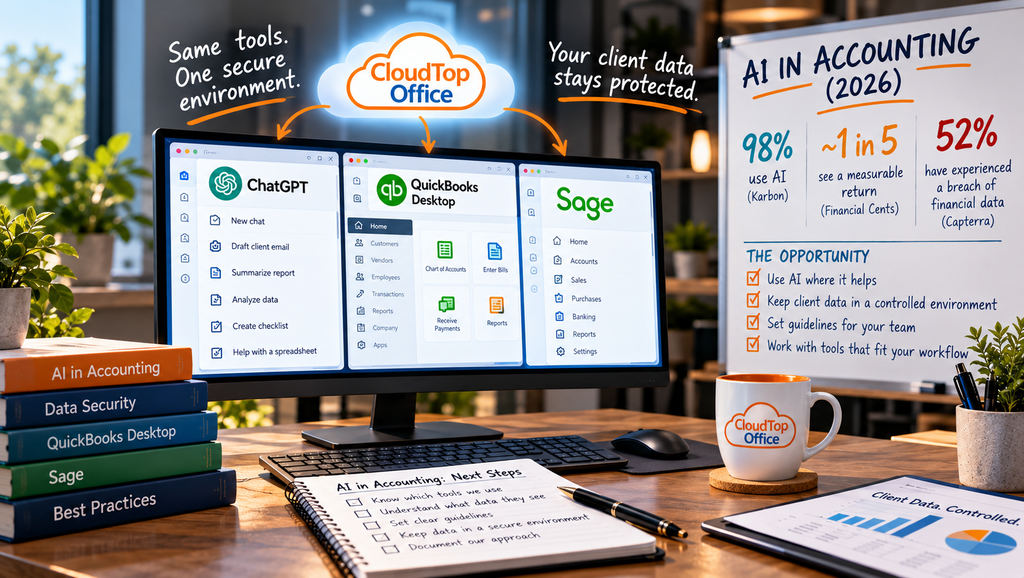
The gap worth paying attention to is not between firms that use AI and firms that do not. It is between using AI and governing it. Financial Cents found that while nearly every firm it surveyed uses AI in some form, only about one in five could identify a measurable return. Capterra found something more pointed: 52% of accounting professionals have experienced a breach of financial data, and fewer than half of firms using AI have any guidelines for what client information staff may enter into these tools. Put those together and the real state of things comes into focus. People are pasting client data into AI tools faster than their firms are writing rules about it. For a profession that answers to the FTC Safeguards Rule and IRS data-security expectations, that is the exposure to close, well before the question of which AI tool is best.
None of this is an argument against AI. The tools are useful, and the firms using them well are getting real time back on data entry and routine review. It is an argument for putting the basics in place first: knowing which tools your staff use, what data those tools see, and where that data goes. Those are plain questions, and most firms have not written down the answers yet.
Where hosted Desktop actually fits
Hosting will not make a firm an AI firm, and it would be a stretch to claim otherwise. Its role here is narrow and real, and it sits on the control side of that gap rather than the capability side. When your QuickBooks or Sage runs in a hosted environment, your client data lives in one managed, access-controlled place instead of on scattered laptops and in whatever tool a staffer tried last week. The AI tools that work with your software can run in that same environment, which keeps the data governed and documentable- the thing most firms are missing. It does not write your AI policy or vet a vendor for you. It gives you a defined place to put the data those tools touch, which is a sensible foundation to build the rest on. We cover that side in our look at running AI bookkeeping tools inside hosted QuickBooks.
So the takeaway is less dramatic than the headline. Nearly everyone is using AI, most in small ways, and the firms that come out ahead will be the ones that pair that use with real control over client data rather than the ones that adopted first. If you want a controlled place to run your accounting software and the tools around it, that is a conversation worth having. You can get a personalized quote or book a short call whenever it is useful.
Book a 15-minute call → to talk through where AI tools and your accounting data could safely live together.
Leave a Reply