

If Your CRM Is Weak, Your Revenue Is Weak
Let’s be clear.
If your sales pipeline lives in spreadsheets, scattered inboxes, or someone’s memory, your growth isn’t scalable. You may close deals. You may even have strong months. But without structure, revenue will always feel unpredictable.
A serious business needs systems.
And that system starts with Zoho CRM.
Zoho CRM is widely considered one of the best CRM platforms for small and mid-sized businesses because it combines flexibility, automation, and reporting in one ecosystem. But software alone doesn’t create performance.
Structure does.
The Real Problem Isn’t the CRM
It’s the Way It’s Set Up
Many businesses invest in Zoho CRM but struggle with proper configuration. A structured Zoho CRM implementation strategy makes the difference between software that sits idle and a system that drives predictable revenue.
We’ve reviewed and restructured enough CRM systems to see the pattern clearly. Most underperforming sales teams aren’t lacking effort they’re lacking architecture.
Pipeline stages aren’t clearly defined.
Automation rules aren’t aligned with the real sales cycle.
Reporting dashboards don’t reflect leadership priorities.
So the CRM becomes reactive instead of strategic.
That’s not a technology problem.
That’s an operational design problem.
What a Properly Structured Zoho CRM Looks Like
When Zoho CRM is implemented correctly, every lead enters through a defined capture process. Every deal moves through intentional Zoho CRM sales pipeline stages that reflect how your business actually closes revenue not generic templates.
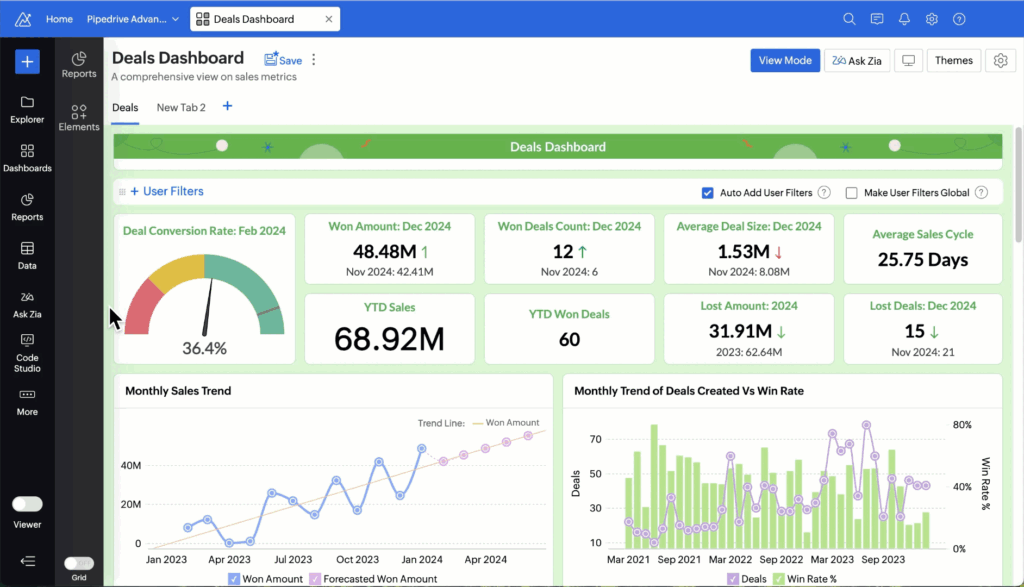
Automation handles follow-ups so no qualified opportunity gets ignored. Tasks are triggered based on stage movement. Forecasting reports give leadership clarity on expected revenue instead of guesswork.
If you’re wondering how to set up Zoho CRM for a small business that wants predictable growth, the answer isn’t “add more fields.”
It’s align the CRM workflow with your real-world sales behavior.
When that alignment happens, performance changes quickly.
CRM Discipline Drives Predictable Revenue
Revenue becomes unstable when deal stages aren’t updated, automation isn’t configured, or reporting isn’t trusted. The moment visibility drops, decision-making weakens.
Marketing can’t see conversion trends.
Sales leadership can’t identify stalled deals.
Finance can’t forecast accurately.
A properly implemented CRM removes that friction. It transforms scattered activity into measurable execution. It gives leadership confidence in their numbers.
And confidence in your numbers changes how you operate.
Where CloudTop Fits
Across multiple CRM audits and pipeline restructures, we’ve seen the same issue repeatedly: companies purchase Zoho CRM, customize it lightly, and assume it’s optimized.
It rarely is.
CRM software doesn’t create growth.
Intentional pipeline design, automation logic, and reporting architecture do.
The difference between a CRM that simply stores data and one that drives revenue performance is structural clarity. Defined stage accountability. Automated follow-up systems. Reporting built for decision-makers not just activity tracking.
Structure determines performance.
And performance determines revenue.
Final Word
Businesses don’t scale because of motivation.
They scale because of systems that enforce consistency.
Your CRM is one of the most important systems in your organization. If it’s under-structured, under-automated, or misaligned with your actual sales process, your revenue ceiling is lower than it should be.
Fix the architecture.
Strengthen the pipeline.
Build predictability.
Everything else compounds from there.
Leave a Reply