

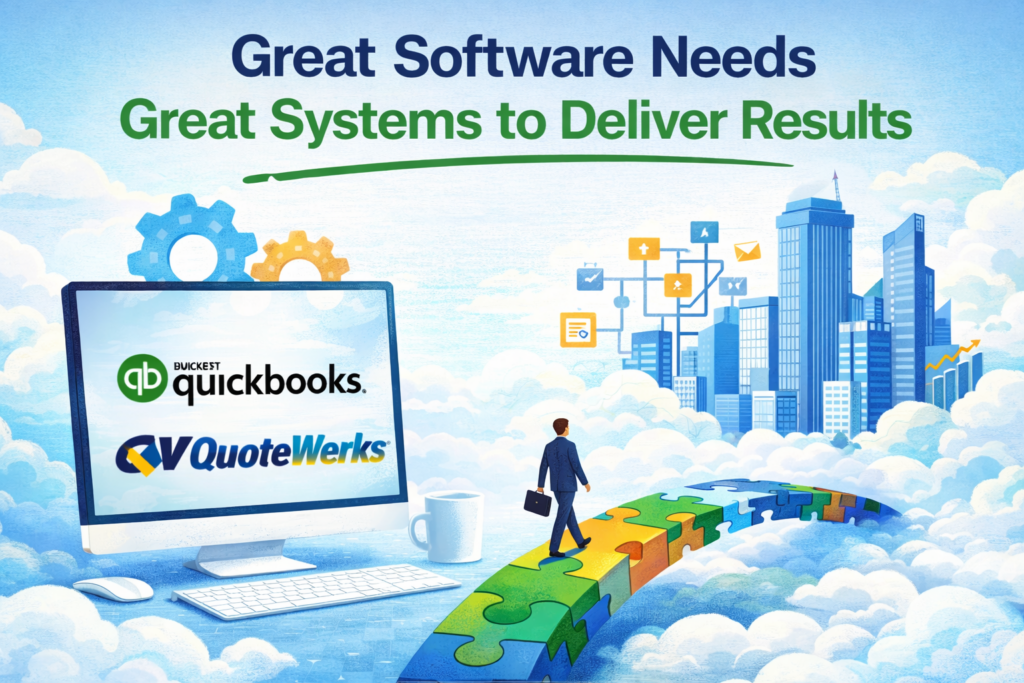
Many businesses invest in powerful software expecting it to transform their operations overnight. Tools like QuickBooks for financial management or QuoteWerks for sales quoting can bring tremendous value to an organization. However, software alone rarely solves operational challenges. The real impact comes when the software is supported by well-structured systems and clearly defined workflows.
Technology works best when it is part of a larger strategy.
Tools Are Powerful — But Systems Create Results
Business software is designed to perform specific functions. Accounting platforms manage financial records. Quoting tools streamline proposal creation. CRM systems track customer interactions.
But tools on their own don’t define how work gets done.
A system, on the other hand, creates structure. It determines how information moves through an organization, who is responsible for each step, and how progress is measured. When businesses build clear systems around their tools, software becomes far more effective.
Without that structure, even the most advanced tools may end up underutilized.
Why Software Alone Doesn’t Solve Operational Problems
It’s common to see businesses purchase new software hoping it will automatically fix inefficiencies. Teams may adopt the tool but continue working the same way they always have.
When that happens, the software simply becomes another application employees have to manage.
For example, an organization might implement QuickBooks but still rely on manual processes for tracking project costs or reconciling financial data. Or a sales team may use QuoteWerks to generate proposals but lack a clear process for managing quotes, follow-ups, and conversions.
The software works, but the workflow around it isn’t optimized.
What Strong Business Systems Look Like
Businesses that truly benefit from technology focus on building systems first. They define how work flows from one stage to another and ensure that software supports each step of the process.
Strong systems typically include:
- clearly defined workflows
- consistent processes across teams
- accountability for tasks and responsibilities
- automation where possible
- reporting that provides real-time visibility
When these elements are in place, software becomes a powerful engine that drives efficiency and growth.
Turning Software Into a Strategic Advantage
The difference between companies that struggle with technology and those that thrive with it often comes down to how systems are designed.
When accounting processes, sales workflows, and operational reporting are structured properly, tools like QuickBooks and QuoteWerks become far more than standalone applications. They become part of an integrated business system that supports smarter decisions and smoother operations.
Instead of reacting to problems, leadership gains the visibility needed to manage performance proactively.
Final Thought
Business software is an important investment, but its value is only fully realized when it supports a well-designed system.
The right combination of tools, processes, and visibility transforms technology from a simple utility into a strategic advantage.
When businesses focus on building strong systems around their software, they unlock the full potential of the technology they rely on every day.
At CloudTop Office, we help businesses design the systems that allow their software to perform at its best — from implementation and integration to secure cloud hosting and operational optimization.
Leave a Reply