
Most service-based businesses don’t struggle with effort.
They struggle with visibility.
Time is tracked in one system. Invoices are created in another. Profitability is reviewed in spreadsheets at the end of the month — if it’s reviewed at all.
When project execution and accounting don’t operate together, profitability becomes guesswork.
That’s where integrating Zoho Projects with Zoho Books changes everything.
The Operational Gap Most Businesses Ignore
On paper, tracking time and sending invoices sounds simple. In reality, disconnected systems create friction:
Time entries have to be exported manually.
Billable hours get missed.
Invoices are delayed.
Project margins aren’t clear until it’s too late.
As teams grow, that friction compounds. Admin time increases. Errors multiply. Reporting becomes unreliable.
The problem isn’t effort.
It’s system alignment.
How the Integration Actually Works
When Zoho Projects integrates with Zoho Books, the workflow becomes structured and automatic.
Projects are created with defined budgets. Team members log billable and non-billable hours directly against tasks. Once time entries are approved, they sync into Zoho Books where draft invoices can be generated immediately.
Instead of re-entering hours or calculating invoices manually, the system connects execution to revenue in real time.
This is what proper Zoho Projects time tracking integration should look like — not extra work, but streamlined flow.
Project → Time Entry → Approval → Invoice → Revenue Reporting.
No duplication. No spreadsheet reconciliation. No revenue leakage.
Time Tracking That Converts to Revenue
Time tracking only creates value when it translates into billing accuracy.
Inside Zoho Projects, hours can be categorized as billable or non-billable. Once approved, those billable hours sync directly into Zoho Books, reducing the risk of underbilling or forgotten entries.
For hourly billing models, this accelerates invoicing and improves cash flow.
For fixed-fee projects, it provides visibility into how actual labor compares to estimated budgets — allowing teams to spot overruns early instead of after margins disappear.
That visibility is what protects profitability.
Invoicing Without Friction
Manual invoice creation slows down payment cycles and increases errors. With Zoho Books invoicing connected to project time logs, draft invoices can be generated automatically based on approved hours or predefined billing schedules.
That reduces administrative overhead and shortens the time between work completed and revenue recognized.
In practical terms, it means fewer bottlenecks and stronger cash flow consistency.
Real Project Profitability — Not Assumptions
The real power of integrating Zoho Projects with Zoho Books isn’t convenience.
It’s financial clarity.
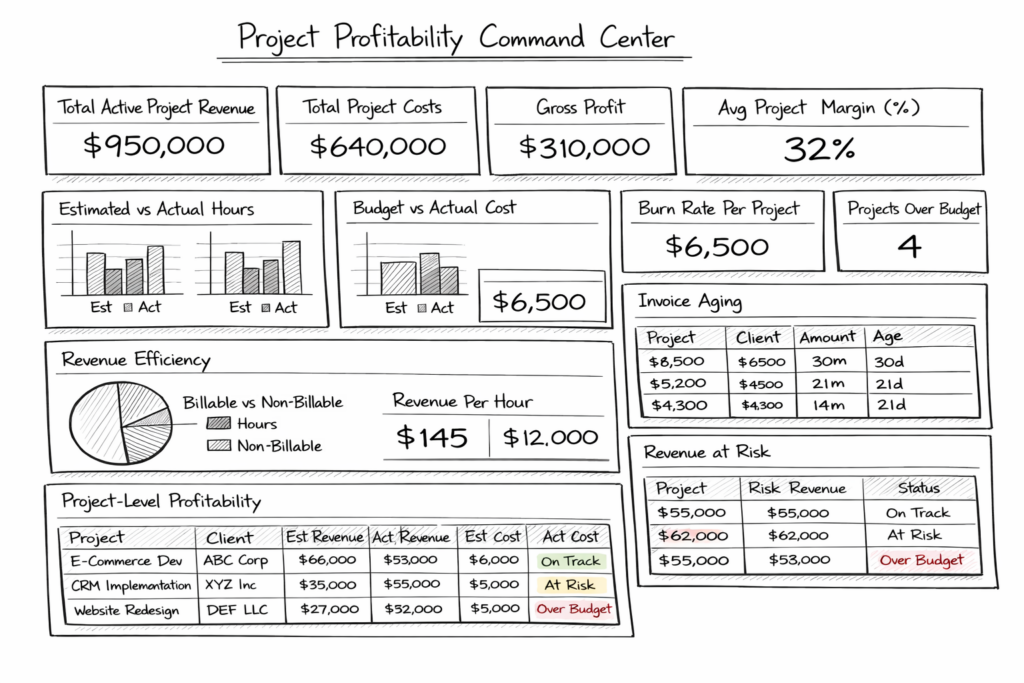
When budgets, labor hours, expenses, and invoices exist inside connected systems, leadership gains a clear view of:
Estimated vs actual costs
Revenue per project
Margin per client
Billable efficiency ratios
Instead of relying on end-of-month reviews, businesses can monitor project profitability in real time and make adjustments before margins shrink.
That’s operational maturity.
Using Both Tools Isn’t Enough
Many businesses use Zoho Projects and Zoho Books independently but never configure the integration properly. Cost categories aren’t aligned. Reporting isn’t structured. Profitability dashboards aren’t built.
Activation isn’t the same as optimization.
The real value comes from aligning workflows so time tracking, invoicing, and financial reporting operate as one system.
Final Thought
Project management without accounting visibility creates blind spots.
Accounting without project-level detail creates assumptions.
But when Zoho Projects integrates with Zoho Books, activity becomes measurable and profitability becomes predictable.
Structure drives clarity.
Clarity drives profit.
Leave a Reply